/
Feed Enrichment: How ChatGPT Finds Your Product When the Right Question Is Asked

Feed Enrichment: How ChatGPT Finds Your Product When the Right Question Is Asked

Written by
Ruben de Weerd
Posted on
Nov. 4, 2026
Reading time
5 minutes
On this page
"First-party data gives you more complete insights."
Laurens
Team Lead and Tracking Specialist

For years, your product feed was primarily a technical file—a list of titles, prices, EAN codes, and images that Google Shopping needed to display your products. As long as the feed was approved, it was good to go.

That’s changing. Since late August, you’ve been able to advertise on ChatGPT in the Netherlands, and Google is also increasingly focusing on AI-powered answers in Search. In both cases, your product data determines whether your product matches the customer’s query—not a keyword. With ChatGPT Ads, it goes one step further: the ad itself is built from your feed.

With ChatGPT Ads, the product feed is essentially the campaign. In this blog post, we’ll explain what feed enrichment is, why it’s worth it, and how to enrich your product feed.

What is feed enrichment?

Feed enrichment means supplementing your product feed with information that goes beyond the basics. You don’t just describe what a product is; you also explain what it’s used for, what you need to use it with, and how it differs from other versions.

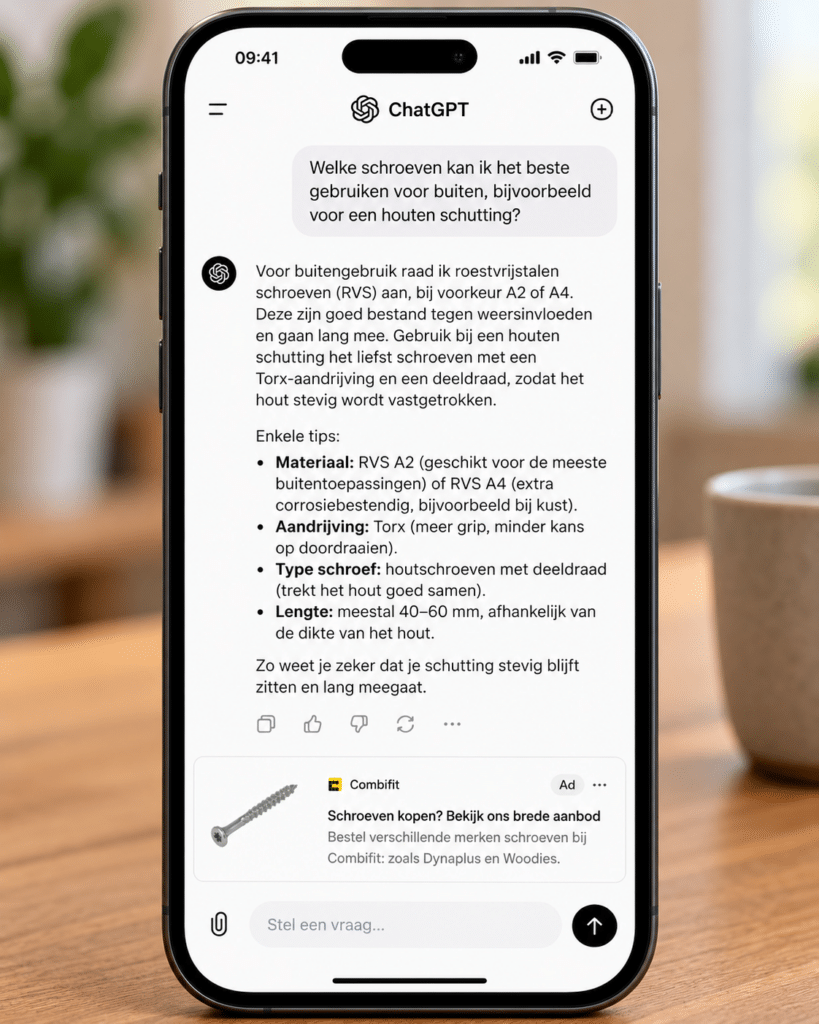
We’re now running ChatGPT Ads for our client Combifit. There, we’re seeing just how differently people search. On Google, someone types “buy screws.” In ChatGPT, the same need is described in much greater detail:

"I want to buy screws for outdoor use. What kind of screws do I need for hardwood decking boards?"

In its response, ChatGPT immediately lists what it looks for: corrosion-resistant material, the correct length and thickness for hardwood, and a countersunk head. If you want your product to match that kind of response, your feed must also include that information—not just the title, price, and size.

Feed enrichment extracts that information and places it in fields that Google and ChatGPT can read.

Example of a ChatGPT ad from Combifit on a mobile device.

Here's what an enriched product feed looks like

An example based on a screw from the Combifit product line. Both feeds include the brand, price, EAN, and image. The difference lies in the additional information:

 Standard FeedEnriched feed
Product TitleUnischroef 5.0×70 42 stainless steel A4 flat head TX 25 Dynaplus 200Dynaplus single-threaded stainless steel A4 screw, 5.0 × 70 mm, flat head
Specifications–A4 stainless steel · partial thread · countersunk flat head
Application–Outdoor, hardwood, and wood: decking boards, fences, garden structures
Goes well with–TX25-bit, the same screw in different lengths
Differences from Variants–A4 stainless steel is more resistant to salt and moisture than A2
Popularity–*Calculated from sales data*

With just the basic information, an AI assistant has to figure out on its own what “stainless steel A4 flat-head TX 25” means. With the enriched feed, it not only knows what the screw is, but also—when you select it—what else you’ll need and why this variant is a better fit than another.


More Than Just Filling in Attributes

Feed enrichment goes beyond just a few extra fields. ChatGPT answers questions like “What kind of screw do I need for my deck?” and requires context to do so. That’s why we enrich feeds in four layers:

  • Specifications: what the product is. Material, dimensions, design. This information is often already listed on the product page, but it isn’t structured in the feed.
  • Context: whenever you choose it. For which applications and situations a product is suitable, and when another variant is a better fit.
  • Relationships: What Goes Along with Them. Accessories, Supplies, and Variants. A customer rarely buys just screws.
  • Performance: Why Choose This Product. Popularity based on real sales data, reviews, and product documentation.


Why Feed Enrichment Pays Off More Now

We already knew this for Google Shopping and Performance Max: the better the data you feed into a platform, the better the platform can make decisions. A strong title, the right category, and complete product attributes can contribute to more relevant matches and better campaign performance.

With AI-powered search environments, that effect is amplified. A traditional feed is designed for a system that matches keywords. An AI assistant needs to understand your product, compare it to alternatives, and answer the customer’s question. If that information is missing, it becomes more difficult to match your product to the right query.

In addition, ads in ChatGPT in Europe are not yet personalized. They are primarily selected based on the context of the conversation, supplemented by signals such as language and general location. So while audience data isn’t a key factor, the quality of your product data certainly is.

Feed Enrichment as the Foundation for ChatGPT Ads

For online stores, ChatGPT Ads revolves around product feed campaigns. You don’t create an ad for each product: OpenAI pulls the title, description, and image directly from your feed. A rich feed therefore results in a better ad. That’s why our approach to ChatGPT Ads always starts with the product data, and only then moves on to the campaign.

The great thing is that, since May 2026, Google has been requesting virtually the same information to help products align better in AI Mode. Both platforms want to know:

  • What is this product?;
  • What you use it for;
  • What's included;
  • and how popular it is.


So you enrich your product data once and use it for both ChatGPT and Google.

How is your feed doing?

Many online stores have set up their product feeds for Google Shopping but still lack the detailed product information required by AI platforms such as ChatGPT. Those who get their product data in order now will be ready for both ChatGPT and Google.

Want to know where your feed stands right now? Have it reviewed with a Product Feed Check, or click the button below to learn how we combine feed enrichment, tracking, and campaigns.

Working together?

I'm Roel, founder of Tomahawk. I am happy to help you from our office in Nijmegen.